
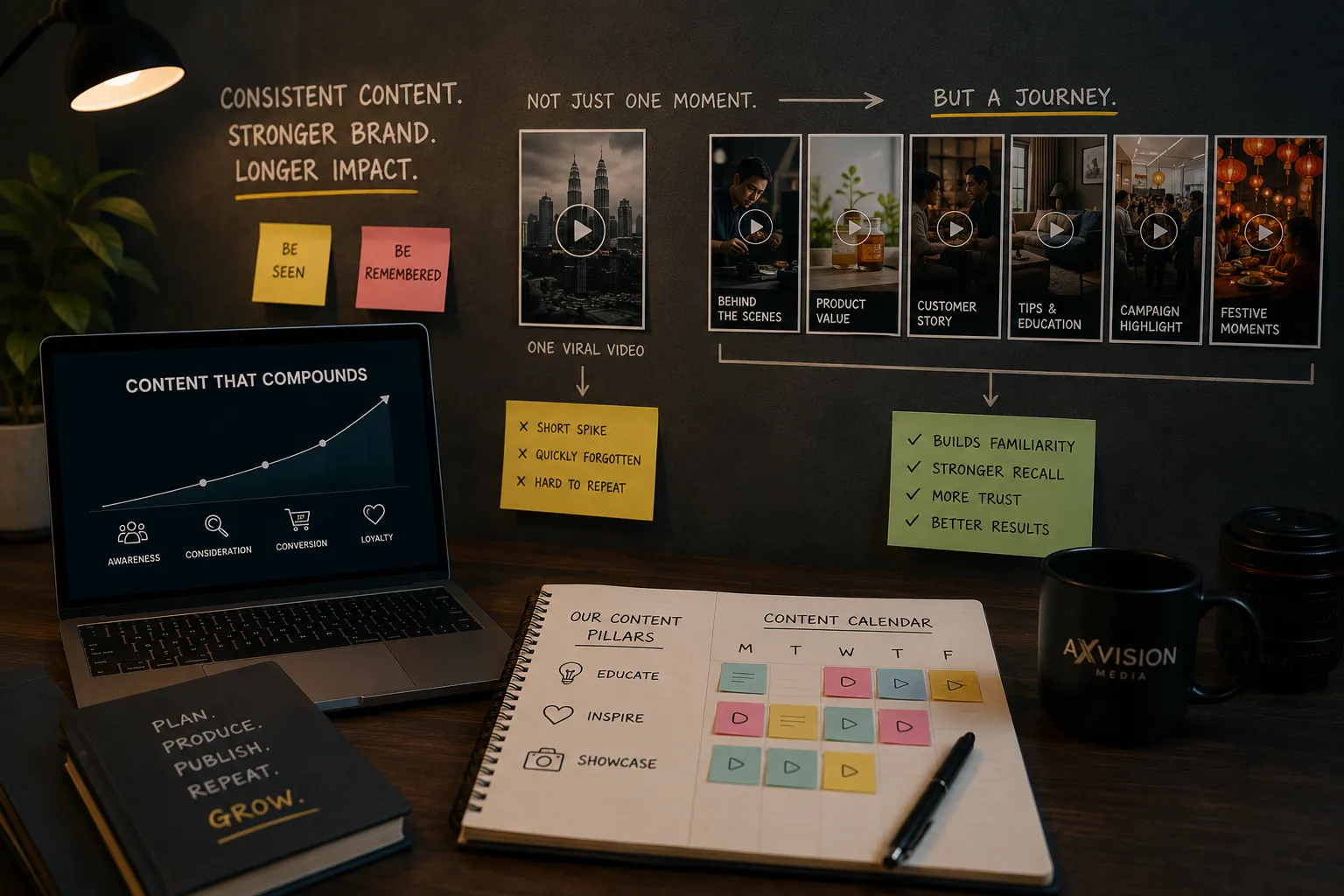
Most brands in Malaysia do not have a content problem. They have a consistency problem. There is a burst of activity around a product launch, a roadshow, or a festive campaign, and then months of quiet until the next big push. The content exists, but the presence does not.
That gap is where brand recall quietly disappears. And it is the reason a single high-performing video rarely delivers the long-term result business owners expect from it.
The Problem With Chasing One Viral Moment
A video that performs unusually well feels like validation. Views climb, comments come in, and the team assumes the formula has been found. But a spike in attention is not the same as a shift in perception. Most viewers who watch one entertaining clip will not remember which brand published it a week later, and platform algorithms move on faster than audiences do.
Virality is also an unreliable production brief. It cannot be scheduled, it cannot be repeated on demand, and it usually rewards novelty rather than the message a brand actually needs to land. Building a marketing plan around it means building on something no studio can promise.
What Consistency Actually Buys You
Consistent output changes the maths. Instead of one asset carrying the entire quarter, a steady stream of content compounds. Each piece reinforces the last, and the audience begins to recognise the brand before they read the name.
1. Familiarity, which shortens the sales conversation
Buyers rarely decide on first contact. When a prospect has already seen your work, your team, and your process across several months of content, the first real conversation starts from a warmer position. You spend less time proving credibility and more time discussing fit.
2. A visual identity people can recognise at a glance
Colour treatment, framing, pacing, typography, and tone all accumulate into something recognisable. This is the difference between a brand that publishes videos and a brand that has a visual language. The second one is far harder for competitors to imitate.
3. Better data to plan with
One video gives you an anecdote. Twenty videos across a few months give you patterns: which topics hold attention, which formats get saved and shared, which hooks work for your specific audience. That evidence is what turns content planning from guesswork into a repeatable process.
4. Lower cost per asset
Planning content in blocks rather than one shoot at a time means fewer setup days, fewer travel trips, and more usable material from every session. A single production day designed properly can supply several weeks of platform content.
Consistency Is Not the Same as Posting More
This is where many brands overcorrect. They move from producing too little to producing constantly, with no structure behind it, and the output starts to feel random. Consistency means predictable quality, message, and look, not maximum volume.
A workable structure usually has three layers:
- Foundation content that explains what the business does, who it serves, and why it can be trusted. This is refreshed occasionally, not weekly.
- Rhythm content published on a regular cadence to keep the brand visible between campaigns.
- Campaign content built around launches, seasonal moments, and events, where budget and reach are concentrated.
When those three layers are planned together, campaigns land on an audience that already knows the brand instead of one being introduced to it from cold.
How to Start Without Overcommitting
You do not need a daily posting schedule to be consistent. You need a cadence you can sustain for at least six months. For most small and mid-sized brands, that means agreeing on a realistic frequency, deciding the two or three content pillars you will keep returning to, locking a recognisable visual treatment, and batching production so shoot days serve several weeks of output at once.
Review quarterly rather than weekly. Short-term numbers fluctuate for reasons that have nothing to do with your content, and reacting to every dip is how brands end up with an inconsistent feed again.
The Takeaway
Viral moments are pleasant when they happen, but they are an outcome, not a strategy. Visibility is built by showing up in a recognisable way, long enough for your audience to form an impression that sticks.
At Axvision Media, this is the thinking behind our long-term visual system approach, and how we structure campaign and seasonal exposure so individual pushes build on each other rather than starting from zero. If you are reviewing your content direction for the year ahead, get in touch and we can map it out with you.